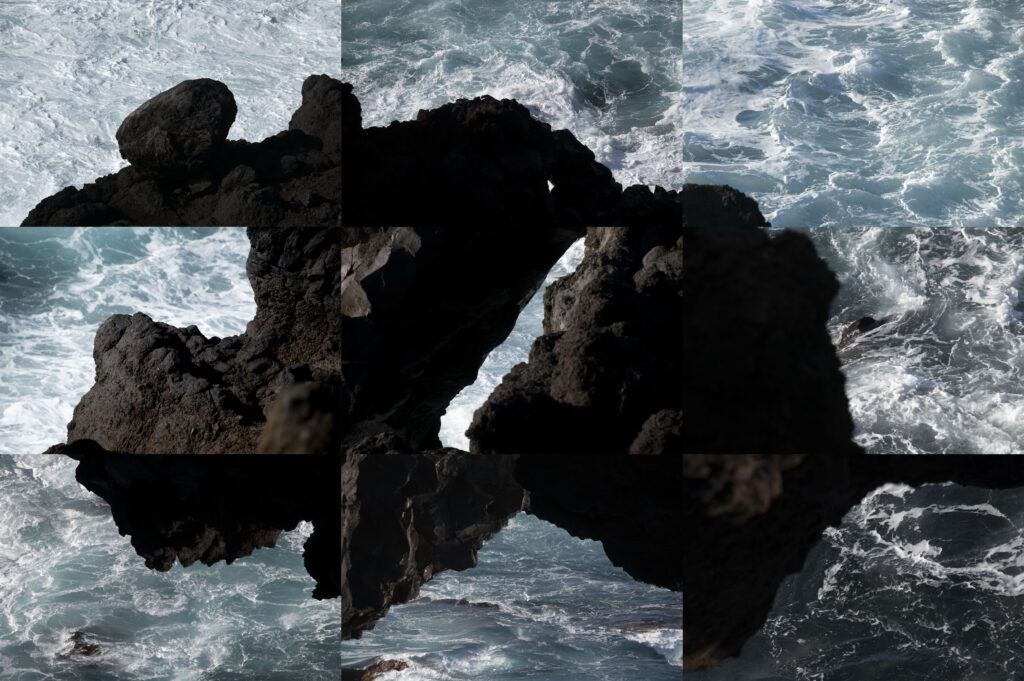
La isla funciona como un espacio de proyección, un territorio donde crear un refugio moral y, al mismo tiempo, buscar sentido frente a un entorno que parece no ofrecerlo. Se presenta como escape, pero también como afirmación: es más que una simple separación; es la posibilidad de imaginar un lugar donde las convicciones encuentren coherencia.
La isla no responde a una cartografía, sino a una construcción mental que opera como refugio en tiempos de conflicto. Más que un lugar apartado donde viven las memorias, es la convergencia de la experiencia y del porvenir. Se trata de un territorio sin materia, pero con estructura. Aunque imaginario, encarna una necesidad: la de formular las bases de un lugar con la intención de materializarse. Esta idealización no niega la realidad, sino que la desafía al proponer una alternativa.
Generar un espacio a partir de restos, como los fragmentos fotográficos, produce espacialidad y, al mismo tiempo, permite construir un ideal, habitar el refugio y trazar el territorio que nos define. Cada fragmento está vinculado a una temporalidad; cada contraste desafía la estructura de un cimiento que perdura.
The island: exploration of the territory
The island functions as a space for projection, a territory where one can create a moral refuge and, at the same time, seek meaning in the face of an environment that seems to offer none. It presents itself as an escape, but also as an affirmation: it is more than a simple separation; it is the possibility of imagining a place where convictions find coherence.
The island does not correspond to a map, but to a mental construct that operates as a refuge in times of conflict. More than a secluded place where memories reside, it is the convergence of experience and the future. It is a territory without matter, but with structure. Although imaginary, it embodies a need: that of formulating the foundations of a place with the intention of materializing. This idealization does not deny reality, but rather challenges it by proposing an alternative.
Generating a space from remnants, such as photographic fragments, produces spatiality and, at the same time, allows us to construct an ideal, inhabit the refuge, and trace the territory that defines us. Each fragment is linked to a temporality; each contrast challenges the structure of a foundation that endures.